

Project Hail Mary Is the Sci-Fi Movie 2026 Needed
In Project Hail Mary, Ryan Gosling plays a man who wakes up alone on a spacecraft millions of miles from Earth with no memory of how he got there. He does not know his name. He does not know his mission. He does not know why his two crew mates are dead in their pods beside him. What he does know, slowly and through sheer scientific instinct, is that he is the last hope for saving humanity from extinction.
Adapted from Andy Weir’s follow-up to The Martian, Project Hail Mary is the film that sci-fi fans have been quietly anticipating for three years. It delivers — and then some.
A Different Kind of ‘Man Alone’ Story
The easy comparison is The Martian. Both films are based on Andy Weir novels. Both center on a lone scientist solving impossible problems in space with limited resources and a lot of math. But where The Martian was a survival story — funny, propulsive, fundamentally optimistic in a crowd-pleasing way — Project Hail Mary is something stranger and more interior.
Mark Watney knew who he was. Ryland Grace does not. That distinction matters enormously. The Martian was about competence under pressure. Project Hail Mary is about identity, memory, and what a person chooses to become when there is no one watching and no one left to save them. The amnesia is not a gimmick. It is the engine of the entire film, the mechanism by which we learn what Grace is made of at exactly the same pace he does.
The premise also trusts something most blockbusters refuse to trust: that an audience will sit with a character who is thinking. Grace spends long stretches of this film reasoning out loud, working through physics problems, running experiments in the dark. In lesser hands it would be tedious. Here, it is riveting — because the film understands that curiosity is a form of courage.
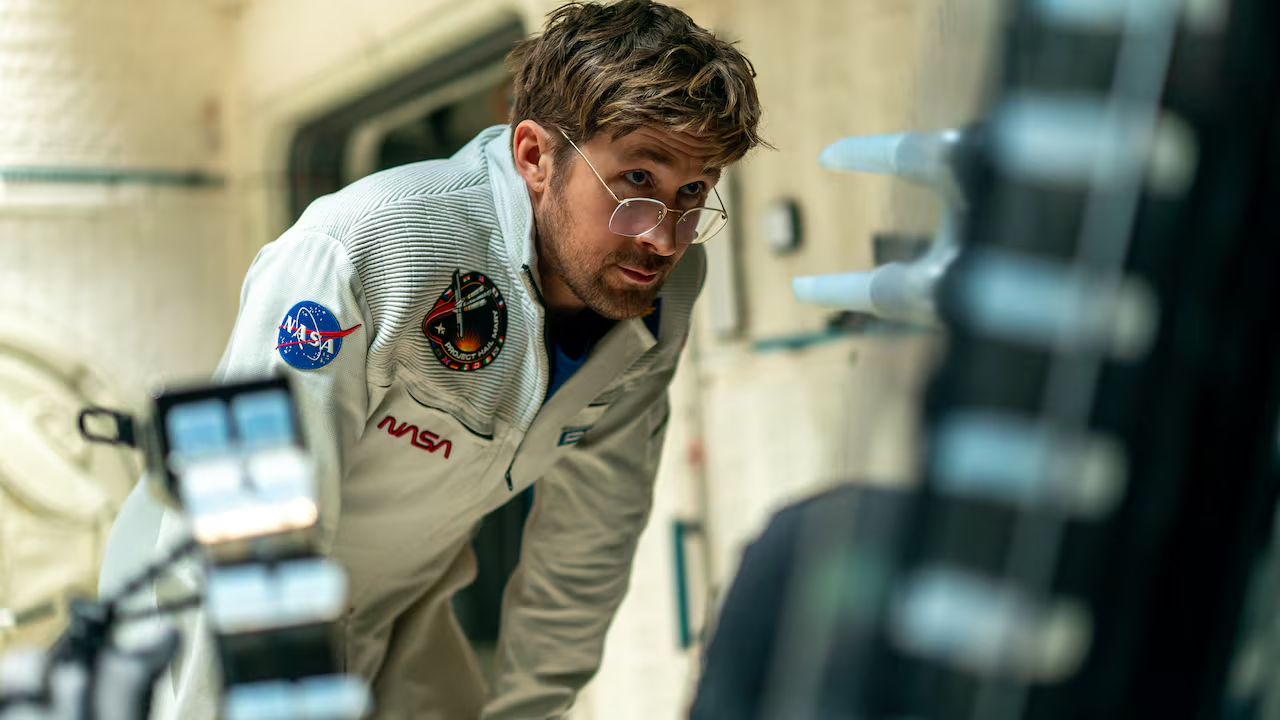
Ryan Gosling Earns Every Frame
There was skepticism when Ryan Gosling was cast, and it is worth acknowledging that skepticism honestly: this is not an obvious Gosling role. It requires him to carry extended sequences alone, to do physical and emotional work that is largely internal, and to sell a kind of wide-eyed scientific wonder that could easily tip into parody.
He does not tip. He soars.
What Gosling locates in Ryland Grace is something genuinely surprising — a man of great intelligence who is also, fundamentally, tender. The performance has almost no armor in it. When Grace makes a discovery, the joy on Gosling’s face is unguarded in a way that feels rare for a movie of this scale. When the film demands grief from him, it lands without announcement, without score swelling to signal the moment. He has done the work to make you care, and then he lets the scene breathe.
This may be the best work of Gosling’s career. It is certainly the most emotionally exposed.
What Sandra Hüller Brings to the Dynamic
To say more about Hüller’s role risks spoiling what the film is doing structurally, but it is worth noting that her casting is inspired. Hüller — who has spent the last three years establishing herself as one of the most compelling screen presences alive — brings an otherness to the film that no American actress would have landed the same way. She is warm and precise and slightly alien in a register that perfectly suits what the story requires of her.
Her dynamic with Gosling forms the emotional backbone of the second half of the film. Without it, Project Hail Mary would be an impressive technical exercise. With it, the film becomes something you will think about for weeks.

How the Film Handles Andy Weir’s Ending
This is the hard one.
Readers of the novel know what the ending asks of its audience. It is not a conventional ending. It does not resolve in the ways that blockbuster films typically resolve, and it makes demands of the viewer that are unusual for a studio production with this budget and this profile.
The film honors it. Completely.
Director Phil Lord and Christopher Miller (who co-write and co-direct here) made the decision to hold the line on Weir’s conclusion, and that decision is the thing that elevates Project Hail Mary from very good to genuinely great. An alternate version of this film exists in some studio notes document where the ending is softened, made more legible, given a more traditional emotional shape. That film would have been fine. This film is brave.
What the ending argues — about connection, about sacrifice, about what we owe to curiosity itself — lands with the full weight of everything that precedes it. It earns the tears. It earns the silence in the theater after the credits begin.
Why This Is the Sci-Fi Movie That Matters in 2026
Not just technically. Not just as an adaptation. As a statement about what this genre can do when it is not afraid of its own intelligence.
The dominant mode of prestige sci-fi in recent years has been spectacle first, ideas second — films that gesture at big questions while keeping their real attention on action choreography and franchise maintenance. Project Hail Mary inverts that. The spectacle is in service of the ideas, not the other way around. The most visually stunning moments in the film are stunning because of what they mean, not merely because of how they look.
There is also something worth saying about the film’s emotional register in this specific cultural moment. Project Hail Mary is, at its core, a film about two beings from completely different worlds choosing to understand each other rather than fear each other. It is about collaboration over competition, curiosity over aggression, and the possibility — not guaranteed, never guaranteed, but possible — that connection across vast difference is worth every cost.
That is not a subtle theme. It is also not an accidental one. In a year that needed it, Project Hail Mary is the science fiction film that arrived exactly on time.
Project Hail Mary is in theaters now.


